
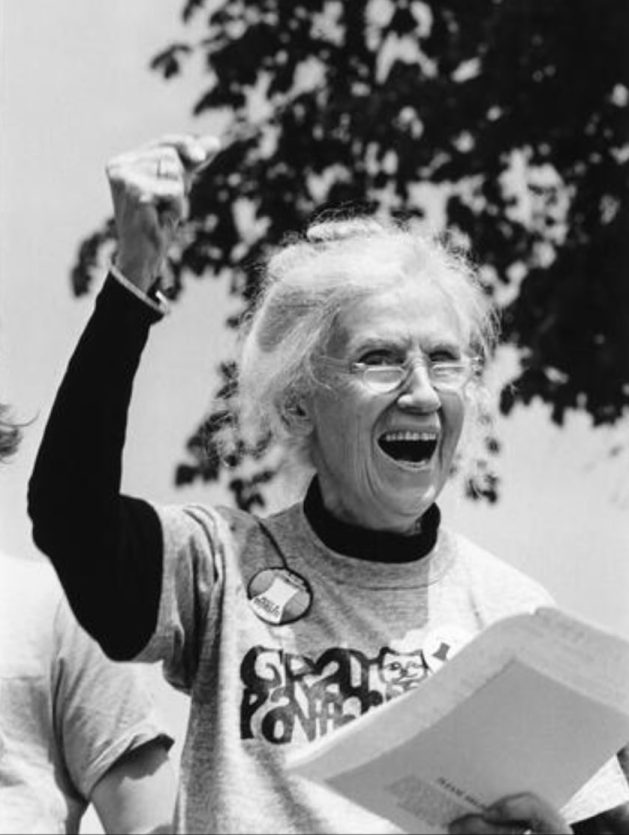
Bob Moses, aka Old Man Moses, wrote the following article 50 years ago as a reporter for the Senior Edition newspaper. Although we have come a long way, we are remarkably still advocating for many of the same changes decades later. Take a look.
SENIOR EDITION
November 1975
CHICAGO, IL – Were I reporting for the Denver Post or the Rocky Mountain News, I would feel obliged to headline this story “Gray Panthers Favor Legalized Marijuana.” Happily, our readers are a more mature group than your garden variety of headline scanners. So, I hope not to lose you if, instead, I tell you about the real beauty of the first national Gray Panthers Conference held in Chicago during October 1975. (I was there.)
Before I go further, I admit my bias. Not only am I an active member of the Denver Gray Panthers, but I am convinced that our National Convener, Maggie Kuhn, has discovered the greatest tonic for old age since the invention of the spinning wheel.
Although she may scold me for saying so, Maggie Kuhn, 70, has transcended old age. Her many wrinkles tell you only that she has lived a long time. She is herself ageless. One quickly gets the feeling that on a personal level she has broken society’s mirror – that insidious piece of Madison Avenue reflecting glass that convinces most of us that we are nothing more than what many of us wish to hell we weren’t – a product of society.
“I don’t take Geritol, I can tell you that!” Maggie told the captivated reporter from Channel 7 TV when he asked where she got so much energy. “The big source of energy,” she explained, “is reaching out to others. It’s a boundless source of energy.”
Maggie’s mission is the humanization of society. And she wants old people to be in the front lines. She often talks about a junkyard on the outskirts of Philadelphia, “crunching broken bodies into scrap metal.” She continues, “As obnoxious as this scene is, I’m glad for it. I’m reminded every time I go by of what this society does to people. We need those grim reminders.”
Society, Maggie argues, has violated “all that we know of human scale. We must get back on the human track. The obsolescence that we have built into products we have transferred to human lives.”
Our Chicago Channel 7 reporter wanted to know if the Gray Panthers had a top priority. Maggie replied, “to stamp out for all time any vestiges of ageism and age discrimination.” She also suggested that the media shared some of the blame for these twin problems, and argued, “The media has a corporate responsibility to affirm life at all ages, not just in the 18-35 bracket where they think all of the money is.”
Maggie concluded the interview. “I’m thoroughly enjoying old age. I just hope I live long enough to see many more people enjoy it.”
§
Maggie Kuhn was not the only Gray Panther in Chicago. With their permission, I want to tell you about some of the other Gray Panthers I was so lucky to meet.
Francesca Poeta, 25, works as an RN in a nursing home in New Britain, Connecticut. She came to the convention, she said, because she is “angry and frustrated” at what she has seen in nursing homes. She talks about hand lotion being diluted with alcohol, orange juice being watered down 4 to 1, and breakfasts consisting of orange juice, coffee, dry cereal, and bread. (“If they are diabetic,” she added, “they get one egg.”) “Sometimes I feel beaten,” she told me.
Lila Burns, 72, is co-convener of the Long Beach, California, Gray Panthers. A widow for eight years, Lila recently came to grips with her feelings of loneliness and moved into an intergenerational commune sponsored by the Lutheran Church. She now lives with a Lutheran minister and eight students of varying ages, with whom she splits housework, cooking, and other household duties. “It’s a very new experience,” she told me, “but a wonderful one,” I asked the Lord to help me in some way not to be so lonely. It seems to me that this is the answer.” Lila recently led the Long Beach Gray Panthers in a successful campaign to convince banks in the Long Beach area to offer extended services, including free checking, to people 60 years of age and over.
The Chicago Gray Panthers are a spirited pack. They paid a “house call” on the American Medical Association at their last convention in Chicago, and in a well-publicized guerrilla theatre performance, the Panther physicians found only wads of dollar bills when they were trying to treat their patient – the AMA – for a heart attack. This year the Panthers held an alternative picnic to “Mayor Daley’s Picnic for Senior Citizens,” and carried signs which read “We want transportation, not peanut butter sandwiches.”
The Boston Gray Panthers were represented by truly a multi-generational trio – Rik Dancey, 29; Isidore Levitt, 85; and Edith Stein. (I still haven’t gotten over my hang-up about asking middle-aged women how old they are.) The easy, uninhibited affection that these three people, differing radically in age and background, displayed toward one another was heartwarming. Together they presented a free-form discussion about their affection for each other and about the difficult process of social change.
Rik: “We need to learn how to keep from getting so caught up in the doing and the acting that it prevents us from being human.”
Edith: “We, too, stumble and succumb. We, too, feel the onslaught of the years. We must not get carried away with action without compassion – action for its own sake. It is easy to get disconnected when you are working on issues from the people you are working with.
Isidore, a Russian Jew who emigrated to the United States in 1906: “I’m having the fun of my life.” (More about Isidore later.)
Gray Panthers in New York are putting together a “Doctor’s Directory” for elderly persons on the West Side of Manhattan. Using the phones of New York’s public television station, New York Panthers conducted a telephone survey of approximately 800 physicians listed as practicing on the West Side. They found out what each doctor charged for office visits, his office hours, whether he accepted Medicare and/or Medicaid, and whether the physician made home visits. The Panthers organizing the project, including Sylvia Wexler, appeared on Bess Myerson’s TV show in New York. When the directory is completed, Sylvia told me, older people in New York will have an easier time finding sympathetic doctors when illness strikes.
Rik Peters, a senior at Bucknell University in Pennsylvania, has put together an intergenerational living experience on campus. Stereotypes fall hard. In one regular discussion group held among the participants, the subject of premarital sex came up. Said a 77-year-old woman, “I’ve been divorced twice, and I don’t think trial marriage is such a bad idea.” Replied one of the under-20 set, “I don’t agree with you. I think traditional marriage is best. I think your problems might be due to something else.”
If I may shatter another stereotype, the marijuana resolution, proposed by the “Under 30’s Issues Caucus” (but open to all ages), was opposed by the two members of the caucus under 25 years of age, and won the backing of the two members over 60 years of age.
In fairness, I should add that when the resolution reached the convention floor, several older Panthers threatened to quit the organization after the resolution passed by a substantial majority. Maggie, in her inimitable style, reminded all that the Panthers were a democratic organization, and offered the dissenters the opportunity to register their dissent in the official record of the convention. The dissenters accepted.
The convention was not without its lighter moments. Eri Fouts, Kansas City delegate, had a few choice words to say about nursing homes. “After listening to and reading three depressing months of reporting on the condition of our local nursing home situation, I have one ambition left in life – to eat my Wheaties and my calves liver, to drink my milk and take my vitamins A, B, C, D, and E, to stay healthy in my old age and stay out of nursing homes! And last but not least – to raise all the hell I can with politicians who allow those unbelievable conditions to exist in our beloved country. Also, to shake up all the middle-aged fannies I can find in America sitting before TV sets lost with Alice in Dreamland, and try to show them some of the realities they better be facing about their old age in America.”
Grace Bowser, Los Angeles Gray Panther, summed it all up in a few words: “You can only make so many paper flowers.”
§
Even the bureaucrats got their two cents in at the convention. An Illinois bureaucrat heavily involved in mass transit problems for the elderly got a warm reception when he pleaded: “Don’t stereotype bureaucrats. I am a bureaucrat. My father was a bureaucrat. Most of my friends are bureaucrats. If I have any kids, they’ll probably be bureaucrats too!
§
Democratic presidential candidate Fred Harris addressed the final session of the conference and called for “graduated income tax instead of graduated tax loopholes,” and claimed that 24 millionaires in the United States paid no income tax in 1974. Harris also proposed that increased Social Security benefits be paid out of a progressive income tax, and charged that the United States is “the only country in the world that pits workers against old people” in the structure of its human welfare system.
§
Back to Isidore. It was fitting that the oldest Gray Panther at the Chicago convention should also be one of the most conscious, sensitive, talented, and at the peak of his expressive power. I call this a blessing. It is enough to make you shiver with anticipation at the wondrous moments that may be awaiting you in old age.
Isidore, 85, was a sign painter. A Russian Jew, born in 1889, he emigrated to the United States at the age of 17. Shortly before, when he was a student at a Jewish technical school, he was exiled to Ukraine by Tsarist police under Nicholas II. A then-famous Russian attorney took his case and succeeded in overturning his exile. Isidore emigrated with his family in 1906 and moved to Boston, where he has lived ever since.
In Boston, Isidore worked for many years as a sign painter, “one of the best in Boston,” by his own admission. With only eight months of formal schooling in this country, he speaks fluent English, Russian, and Yiddish and can read Italian and German.
At the age of 52, Isidore was crippled by a serious illness involving his sacroiliac. His doctors told him he would have to wear braces for the remainder of his life. After a year, when the brace wore out, Isidore threw it away. And began to exercise. It took him several days to learn to roll over. He devised exercises to eliminate his need for the brace, practiced strenuously, and has not worn it since.
During the dark days of his illness, in great pain and believing he would never walk again, he wrote – “When I realized that never again would I feel good about motion and dance, this new power came forth. I woke up one day feeling this is a tremendous gift given to me.”
Isidore began to write poetry. He still writes and recites daily. In “Outlook” (below, composed at age 85), he looks to the coming 15 years. “Fate willing and I age 100,” he writes. With these few words, you feel the full effect of his rich, weathered voice and animated delivery – 85-year-old eyes dancing like raindrops off a crystal lake on a sun-bright day.
Outlook
by Isidore
Fate willing and I age 100,
I’ll grow a beard –
length and spread to suit its own white whim –
and no one else’s
My forbears since time immemorial never sheared nor
shaved,
and I’ll be in true tradition.
With this my look of anciency,
I’ll throw the biggest party ever for kin and comrades,
young and old alike,
hear some poems read – mine and others’ —
then propose a toast to an unpolluted earth to come,
to be followed by people singing and dancing.
And will I not join in!
Unobserved, soon after,
I shall proceed to nearby summer woods,
there to take in primeval scents and sounds,
delight in mosses, grass and trees –
in the limpid theme and glory of them –
as in early Russian years I was wont to do…
And lastly, having found a spreading oak,
I shall lie me down beneath it
and, in consonance with nature’s law of balances,
dream the perfect expiration in some surroundings such
as these
before my days become a burden and embarrassment
to a single soul.
As it is – being four years plus under 90 –
I don’t mind waiting to round out a century of some
valor and deep love.
§
At a particularly tense moment on the floor of the convention, a Chicago delegate vented some intense anger and frustration to the assembled delegates, and walked out, leaving the rest of us in various states of shock, anger, frustration, and lethargy.
Maggie rose and walked to the podium. Silence cloaked the room as her eyes peered compassionately among the emotionally charged and exhausted delegates.
“You know,” she said, “this is the last time that all of us will be here together.”
§
Let’s make the most of it.

Leave a Reply