
What the Tibetan Book of the Dead Taught Me About a Day I Never Forgot
by Jeff Jerebker
The opening lines of the classic folk song “The Water Is Wide” go like this: The water is wide, and I can’t cross over. I once wrote (in my book Hope Rising) about standing frozen on a bridge — caught between the hedonistic, secular world I was leaving and the promise of something quieter and more spiritual on the other side. I thought I might perish on that bridge. Then, somewhere in the surrender, I found myself on the other side. A happy ending, one might say.
But let’s go back to the beginning.
March 1st, 1962
I was seventeen years old, a freshman at Syracuse University. My life felt mapped out — and then, abruptly, it wasn’t.
My parents had boarded a plane at Idlewild Airport (now JFK), bound for Los Angeles. Seconds after takeoff, the plane went down in Jamaica Bay. There were no survivors. My parents had no estate plan in place.
That was the prelude.
The months that followed were a blur of familial and legal dysfunction — grief compounded by chaos. I yearned to return to Syracuse, to put the tragedy behind me and find some footing again.
The Dream — Or Was It?
A few days after returning to campus, something happened in my dorm room that I have carried with me, largely in silence, for over sixty years.
If a hypnotist had asked me decades later whether it was a dream, I would have said no. But I had no alternative explanation — so I avoided discussing it altogether. There was also a book I kept at arm’s length for decades, probably because I wasn’t ready for it: The Tibetan Book of the Dead.
What happened that day was this: my father appeared in my room. He was standing, looking at me. I stood looking back. He did all the talking. He told me they had switched to separate planes at the last minute. He said it had taken him this long to recover, and that he was back now — ready to be my dad.
And then he was gone.
The Walk That Changed Things
Decades passed. Then, in 2025, something moved me in a way I didn’t expect.
The Buddhist Walk for Peace set out from Fort Worth, Texas — a 2,300-mile trek to Washington, D.C. I watched it unfold, and if I hadn’t seen it with my own eyes, I’m not sure I would have believed it. In times as cruel and dispiriting as these, the sight of monks walking through all kinds of weather — disciplined, silent, purposeful — drew crowds along the roadsides that seemed to grow with each passing day. Some people wept. Some bowed. Some celebrated. All were visibly affected.
Was this the ghost of Gandhi? A kindred spirit — leading a nonviolent peace movement during a period of ruthless immigration crackdowns, of innocent people brutalized, of an America I barely recognized? The Walk felt like a flickering light at the end of a very long tunnel. A balm to a deep wound.
I am not a Buddhist. Neither were many of the people who lined those roads. None of that seemed to matter. The power of their discipline — the compassion made visible and physical — cut right through.
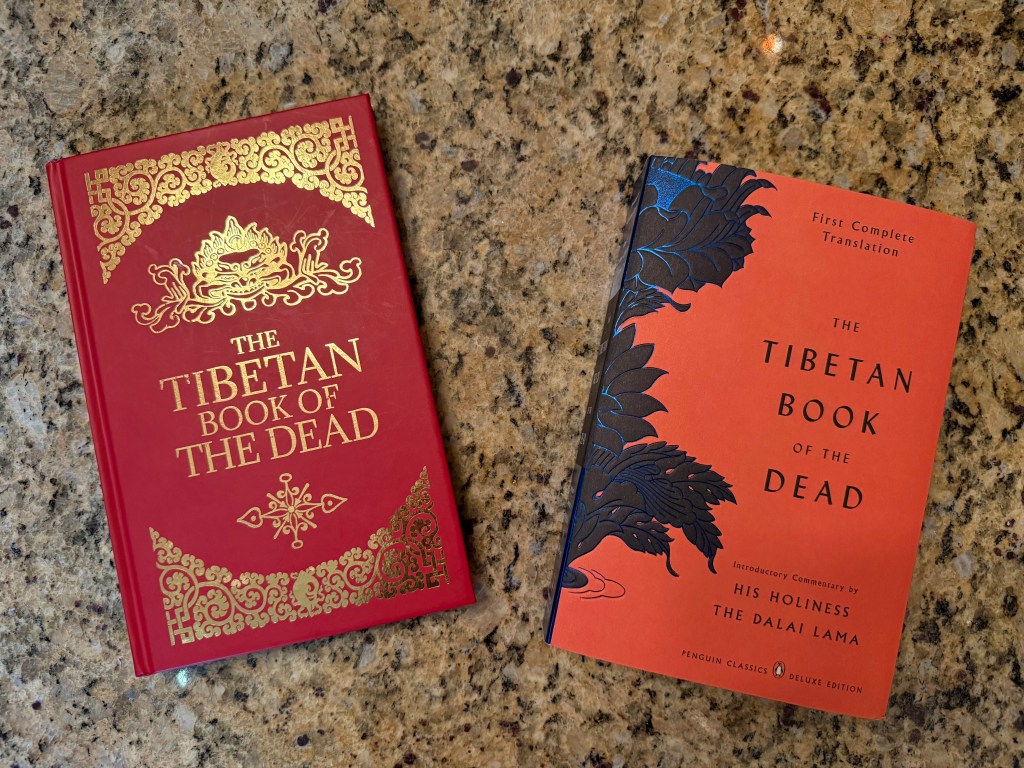
One thing led to another, and I finally decided to read The Tibetan Book of the Dead.
I didn’t realize it might hold the answer to what happened in that dorm room in 1962.
Reading the Book
The Tibetan Book of the Dead describes what it calls the Bardo — the intermediate space between death and reincarnation. In the Tibetan tradition, the 49 days following death are a kind of passage, a period that determines whether the deceased has reached enlightenment (and therefore has no need for reincarnation) or descends through various states: from holy person to demi-god to human to animal, etc., in an ongoing cycle of return. It is through the Bardo that my parents would have traveled.
During this passage, the deceased encounters visions — demons, fear, blissful clear light, and apparitions. Some apparitions are wrathful. Some are peaceful. Some are neutral.
And then came the moment I can only describe as an aha.
Could this be what happened in my dorm room? My father had appeared within the 49-day window. He spoke. He said what he needed to say. Then he was gone. The Tibetans who wrote this treatise centuries ago were considered among the wisest and most penetrating of thinkers. Suddenly, what had happened felt less inexplicable — and more like something that had a name.
It also explained why I said nothing. Just stood there. My father was the one with work to do — working out the karma of his next passage. I was simply present for it.
I have never believed that what I experienced that day was a dream. I don’t sleep in the middle of the afternoon. And there was no waking up — because I was already awake.
After 64 years, I finally have an explanation. Or at least a possible one. As mysterious as it remains, it is more than I had before. And with it came something I didn’t expect: the feeling of a weight lifting from my shoulders.
Yes, the water was wide.
I believe I crossed the Rubicon.
It only took 64 years.


 The Tao of Aging
Leave a comment